


Introduction
Just a decade ago, the idea of solar plants floating on water seemed almost unimaginable! Yet today, floating solar holds estimated potential of 207 gigawatts in India as per recent study conducted by Indo-German Technical Cooperation on Innovative Solar . Under conservative assumptions, it could double the current global installed capacity of solar PV. This innovation offers a promising solution for countries like India to meet their international commitments in combating climate change. As we move towards a sustainable future, with ambitious goals like India’s target of 500 gigawatts (GW) of renewable energy by 2030, exploring alternative methods for clean energy generation—especially utilizing scarce land and harnessing the power of water—has become crucial. Let’s dive into the world of Floating Solar Photovoltaic (FSPV) and its potential.What is Floating Solar –
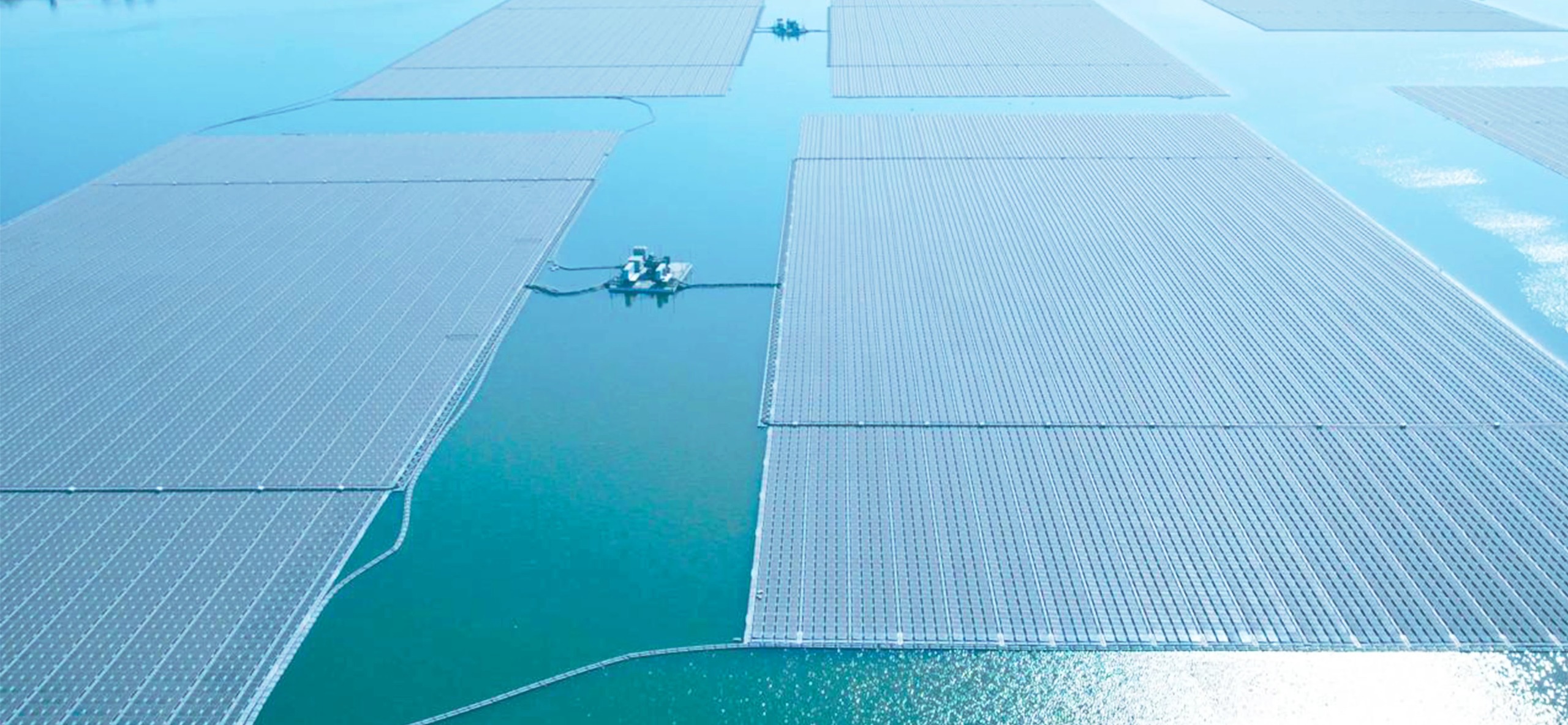
Floating Solar refers to a solar energy system in which photovoltaic (PV) panels are specifically designed and installed to float on bodies of water, such as reservoirs, hydroelectric dams, industrial ponds, water treatment ponds, mining ponds, lakes, and lagoons. These PV modules are typically mounted on pontoon-based structures, with the entire floating system anchored and moored securely to prevent movement. This innovative approach not only maximizes land use efficiency but also offers unique advantages in terms of cooling and space utilization (Refer Figure-1)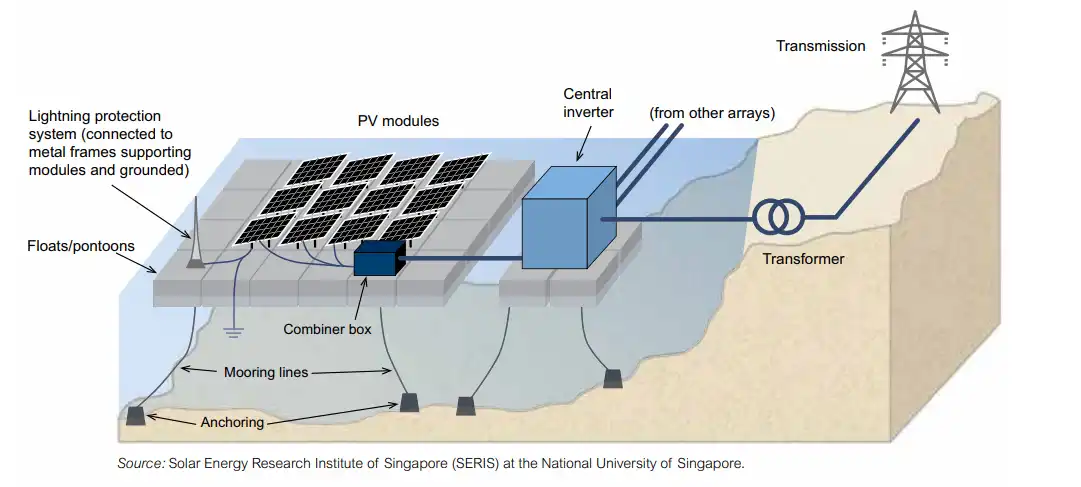 The first FPV system was built in 2007 in Aichi, Japan, followed by several other countries, including France, Italy, the Republic of Korea, Spain, the United States, China, India and other Asian countries.
Opportunities for Floating Solar in India
India, with its vast number of man-made reservoirs, presents a significant opportunity for harnessing floating solar photovoltaic (FSPV) technology. These reservoirs, crucial for irrigation, hydroelectric power, water supply, and navigation, often face high evaporation losses due to the country’s prevalent high temperatures and arid conditions. The Central Water Commission (CWC) estimates that evaporation losses from these water bodies range from 1.5 meters to 3.0 meters annually per square kilometre. This highlights the potential for FSPV to serve a dual purpose—generating clean energy while mitigating water loss through evaporation. A recent report prepared under the Indo-German Technical Cooperation on Innovative Solar (IN Solar) estimates that the inland still water bodies in India have the technical potential to support up to 206.7 GWp of floating solar PV capacity. To determine this potential, the team analysed GIS-based data for all water bodies in India, referencing the Copernicus Programme by the European Commission. They filtered the data to include only those water bodies with usable areas greater than 0.015 square kilometres, consistent water availability for 12 months, and excluded protected zones. Additionally, only water bodies with global horizontal irradiance (GHI) of more than 3 kWh/m² per day and a distance of less than 25 km from a 132 kV substation were considered. The study identified a total of 3,101 square kilometres of suitable water body area. Madhya Pradesh stands out as the state with the highest floating solar potential, estimated at 40,117 MWp, followed by Maharashtra at 32,076 MWp. The initiative is part of a project guided by the Ministry of New and Renewable Energy (MNRE) and funded by the Deutsche Gesellschaft für Internationale Zusammenarbeit GmbH (GIZ), with Ernst and Young LLP (EY LLP), CSTEP, and Fraunhofer ISE (Germany) as partners. The project aims to explore the potential of innovative solar applications that minimize land use and contribute to India’s ambitious solar energy expansion goals. This development could significantly reduce water evaporation from reservoirs while simultaneously advancing India’s renewable energy sector, providing an efficient and sustainable solution to both energy and water conservation challenges.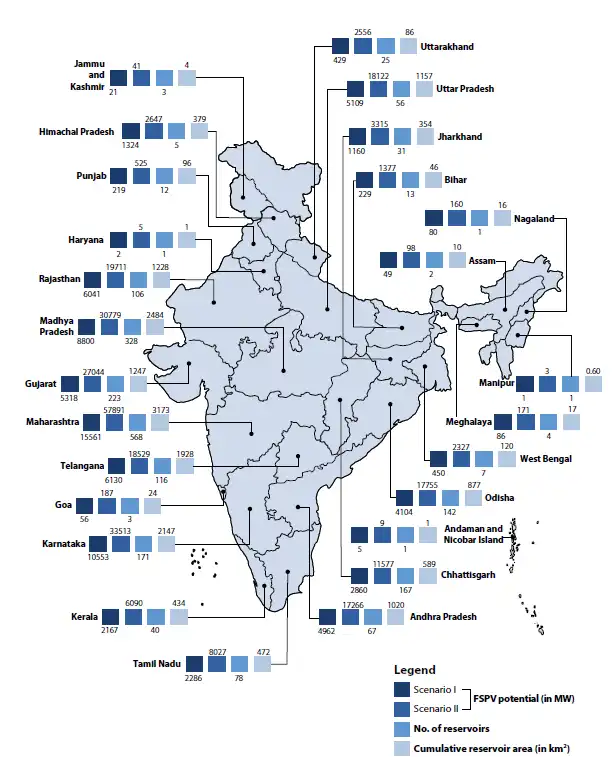
Figure-2
State wise Estimated Potential
Source TERI Analysis While the floating solar photovoltaic (FSPV) technology has significant potential in India, there is currently limited data on its long-term viability and performance. This lack of data raises concerns about the ability to scale the technology effectively across the country. To fully capitalize on the benefits of FSPV, it is crucial to focus on creating local expertise and conducting thorough monitoring of initial projects. These pilot projects will offer valuable insights into the technology’s long-term impact, allowing for the development of standards and guidelines for future projects. The study emphasizes the importance of learning from early installations to understand the challenges and opportunities associated with FSPV. The insights gathered from these projects can be used to refine processes, improve efficiency, and establish best practices. Moreover, based on the data collected, the study aims to assess the difficulty levels of setting up FSPV projects at different locations and rank them into three priority categories: Priority I, Priority II, and Priority III.Priority I: Low-Hanging Fruit
- Characteristics: These are locations where the conditions are most favourable for installing FSPV plants, requiring the least amount of additional technical know-how or infrastructure development.
- Ease of Installation: These sites are considered relatively easy to install, as they align closely with the existing capabilities and knowledge available in the market today.
- Minimal Technical Barriers: These areas are expected to have minimal technical challenges or obstacles, such as shallow depths, favorable solar radiation, and proximity to grid infrastructure.
- Focus: Priority I locations are essentially low-risk, quick-to-deploy sites, which can serve as the initial testing grounds for FSPV technology.
- Characteristics: Locations that present moderate challenges in terms of installation and require a greater level of technical expertise or customized solutions.
- Installation Complexity: These sites may face some logistical or technical difficulties, such as deeper waters or more complex environmental conditions, but are still manageable with existing technology and knowledge.
- Moderate Technical Barriers: These areas may require some adjustments or specialized solutions to ensure successful implementation, but they are still feasible for FSPV projects.
- Characteristics: These locations are the most challenging in terms of installation, requiring significant technical innovation or specialized solutions to address obstacles.
- Installation Complexity: These sites may have deep waters, difficult environmental conditions, or significant distance from necessary infrastructure, making them complex and costly to develop.
- High Technical Barriers: FSPV installations in Priority III locations may face significant engineering challenges, and it may be necessary to develop new technologies or adapt existing solutions to make the projects viable.
Why do we need FSPV?
Floating Solar (or Floating Solar PV) is rapidly gaining attention due to several compelling factors, particularly in response to the growing global demand for renewable energy and the need for more efficient space and resource utilization. The key advantages of floating solar include the ability to generate renewable energy without occupying valuable land, which is essential in densely populated or agricultural areas. The cooling effect from the water enhances the efficiency of solar panels, leading to higher energy output. Additionally, floating solar helps reduce water evaporation, while minimizing conflicts over land use. It can be deployed on existing water bodies like reservoirs and lakes, preserving land for other purposes. Furthermore, floating solar can be integrated with established infrastructure, such as hydropower, and offers an effective solution for energy generation in remote or water-scarce regions. In this way, floating solar contributes to a more sustainable and resource-efficient energy future.Floating Solar Project in India
“Today, when the energy sources and excesses of our industrial age have put our planet in peril, the world must turn to the sun to power our future.” – PM Modi at the launch of the International Solar Alliance To harness the potential of solar electricity, the government is now bringing the spotlight on solar power plants on water bodies. India has many floating solar power projects, including those in Madhya Pradesh, Kerala, Telangana, and Chandigarh. India’s largest Floating Solar Project is Omkareshwar Floating Solar Power with 600 MW targeted capacity at the cost of 3000 crores located in Madhya Pradesh. The Omkareshwar Floating Solar Project, upon completion, will become the world’s largest floating solar power plant. Spanning an impressive 1,631 acres, the project has already commissioned 287 MW of capacity. This includes contributions from AMPIN Energy Transition (100 MW, with COD on June 7, 2024), NHDC (88 MW, with COD on October 29, 2024), and SJVN (90 MW, with COD on August 8, 2024). Additionally, a second phase of 300 MW is expected to go out for bidding soon. Located on the Narmada River in the Khandwa district of Madhya Pradesh, the project will help prevent 1.2 million metric tons of CO2 emissions annually, which is equivalent to planting 15.2 million trees. According to government reports, the floating solar panels will prevent the evaporation of 60% to 70% of the water beneath, which is comparable to the drinking water supply for the residents of Bhopal for 124 days.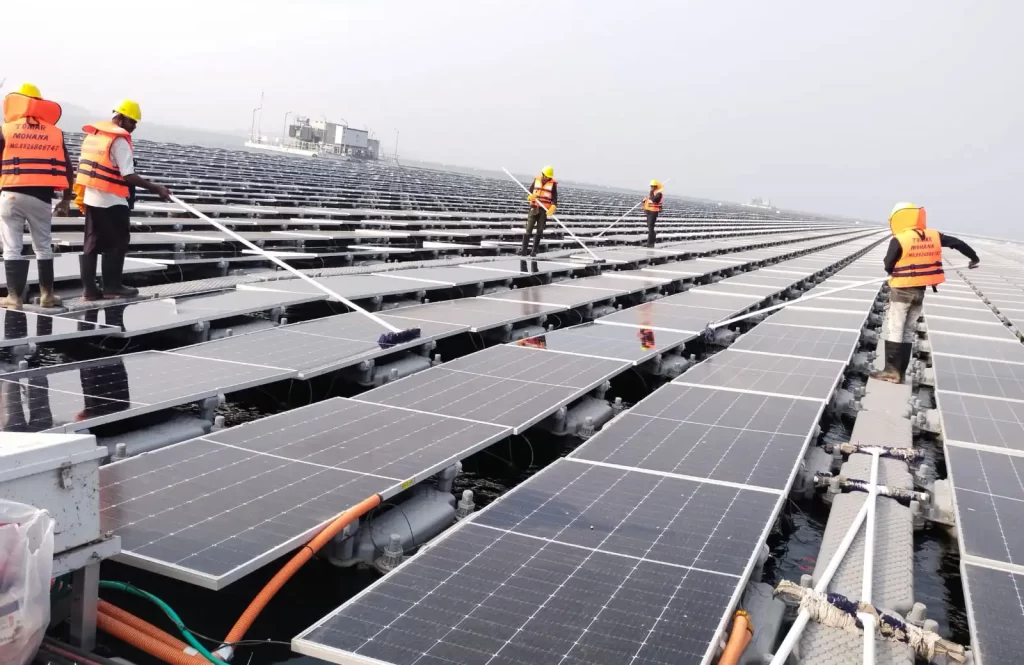 AMPIN Energy Transition RUMSL 100 MW Floating Solar Plant
Furthermore, as a point of pride for India, other floating major solar projects in India: –
- Ramagundam Floating Solar Project- 100 MW-Telangana
- Kayamkulam Floating Solar Power Plant-92 MW- Kerala
- Simhadri Floating Solar Power Project-25 MW- Andhra Pradesh
- Chandigarh Floating Solar Power Plant-2 MW- Punjab
- Mudasarlova Reservoir Floating Solar Power Plant- 2 MW – Andhra Pradesh


AMPIN Editorial
At AMPIN Transition, our editorial team is dedicated to delivering credible, well-researched insights on clean energy, infrastructure, and sustainability. We aim to make complex topics simple and engaging - offering updates, practical tips, and thought leadership that help decision-makers and readers alike stay informed, inspired, and empowered on the journey toward a greener, more sustainable future.