


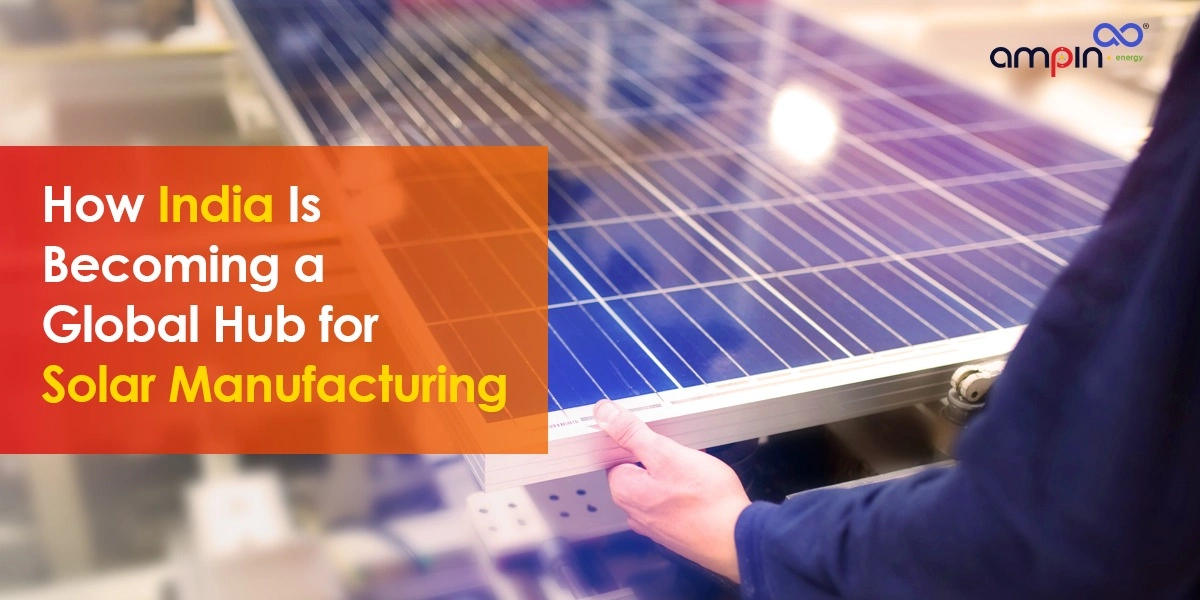
India’s transition from a predominantly solar consumer to an emerging global manufacturing hub for photovoltaic (PV) technology is one of the most under-appreciated success stories of the energy transition era.
Driven by strategic policy interventions, rapid capacity expansion, and growing private-sector investment, the country is strengthening both its domestic energy security and its position in global clean-energy supply chains.
Here’s how this transformation is happening with the help of solar panel manufacturers, and why it matters.
The Manufacturing Imperative: From Deployment to Production
India has set some of the world’s most ambitious renewable energy targets. With a non-fossil fuel capacity target of 500 GW by 2030, solar energy sits at the heart of the strategy. Solar installations have surged, with utility-scale and rooftop solar adding several tens of gigawatts annually, but this rapid deployment created a pressing need: local manufacturing of solar cells and modules to reduce import dependence and stabilise costs.
Between 2022 and 2025, Indian solar PV manufacturing capacity has expanded dramatically. By mid-2025, India’s operational manufacturing reached approximately 120 GW of solar modules and around 29 GW of solar cells, scaling sharply from near-zero domestic cell production just a few years prior.
Policy Push: Production Linked Incentive (PLI) Scheme
The single most transformative driver has been the Government of India’s Production Linked Incentive (PLI) scheme tailored for high-efficiency solar PV manufacturing.
Under this scheme:
- ~48.3 GW of solar module manufacturing capacity has been awarded across multiple firms.
- As of mid-2025, roughly 18.5 GW of solar module capacity, 9.7 GW of solar cell capacity, and 2.2 GW of ingot-wafer capacity have already been established under the PLI framework.
- The Indian industry has created ~43,000 jobs across nine states through PLI-linked solar manufacturing projects by late 2025.
Crucially, the scheme links incentives to actual production output, encouraging investment from the best solar panel companies in advanced technology lines rather than just capacity announcements.
This ensures India is building a globally competitive manufacturing capability.
Building Scale Across the Value Chain
Solar manufacturing spans multiple stages of the value chain:
- Polysilicon production: the raw material
- Ingot and wafer fabrication: forming the crystalline base
- Solar cell manufacturing: where electricity generation happens
- Module assembly: packaging cells into durable, installable units
Until recently, India’s domestic solar ecosystem was concentrated mainly in module assembly, often using imported cells. That has shifted rapidly. Domestic cell and upstream capacity now account for an increasing share of overall capability, a key factor for supply-chain resilience.
Industry projections estimate that India’s module manufacturing capacity could exceed 165 GW by 2027 as PLI incentives drive further expansion, a market scale that positions India alongside major producers like China and the U.S.
Technology Adoption and Quality Standards
Manufacturing efficiency and technology matter as much as scale. India’s solar capacity now includes a mix of modern cell technologies:
- Monocrystalline and PERC cells dominate current production, offering higher efficiencies than earlier polycrystalline cells.
- Advanced processes like TOPCon (Tunnel Oxide Passivated Contact) and emerging heterojunction cells are gaining traction, indicating India’s move beyond basic manufacturing into premium, high-efficiency technology segments.
Domestic production of larger wafer sizes (e.g., M10 and G12) further improves module yield and reduces per-watt costs, a critical performance metric in utility-scale deployment.
Strategic Private Sector Leadership
While policy provides the framework, execution on the ground is driven by industry participation. At AMPIN Energy Transition, we are supporting this shift through a strategic joint venture with Jupiter International Limited to set up a solar cell and module manufacturing facility in Odisha.
The facility, with a planned capacity of up to 1.3 GW cell and up to 1.9 GW of module under the PLI framework, strengthens our backward integration, improving supply-chain control, cost efficiency, and quality assurance.
It will also cater to third-party developers, contributing to both domestic deployment and export growth, reflecting the growing maturity of India’s solar manufacturing ecosystem.
Also Read:How Solar Power Can Enhance Your Business Resilience Against Energy Price Fluctuations.
Global Context and Future Outlook
Despite rapid growth, India still navigates challenges, including reliance on imported raw materials like polysilicon and competitive pressures from established global producers. However, domestic manufacturing capacity has more than doubled in recent years, and job creation, technological upgrades, and export potential continue to strengthen.
As China diversifies its export markets and global demand for clean energy components skyrockets, India’s growing manufacturing base offers an alternative supply source, not just for its own ambitious energy targets but for international markets too.
India’s evolution into a solar manufacturing powerhouse is the result of strategic policy architecture, targeted incentives like the PLI scheme, and visionary industry partnerships.
With domestic capacity scaling rapidly, technology adoption deepening, and integrated manufacturing ventures coming online, India is now shaping the global solar manufacturing landscape.


AMPIN Editorial
At AMPIN Transition, our editorial team is dedicated to delivering credible, well-researched insights on clean energy, infrastructure, and sustainability. We aim to make complex topics simple and engaging - offering updates, practical tips, and thought leadership that help decision-makers and readers alike stay informed, inspired, and empowered on the journey toward a greener, more sustainable future.